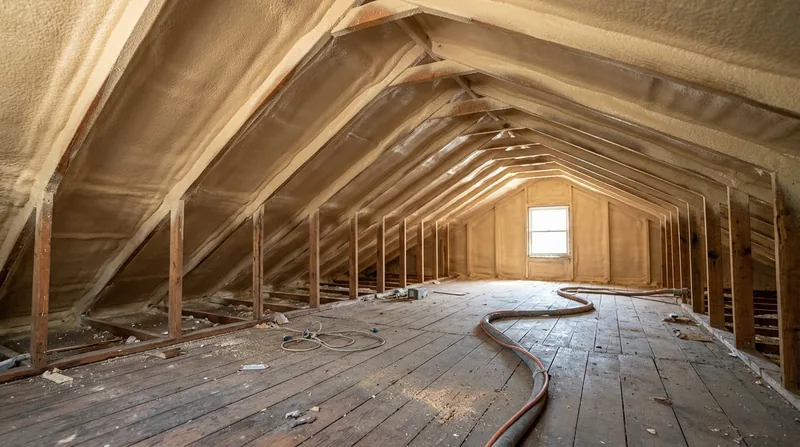




Attic Spray Foam Insulation in Fort Smith turns vented attics into conditioned space, stopping the heat that drives cooling bills up all summer long across the Arkansas River Valley. Fort Smith's housing stock runs the full spectrum: Belle Grove's century-old homes with bare floor joists and original wall cavities, mid-century ranches on slabs with vented attics where fiberglass batts have settled flat over decades, and newer two-story builds near Chaffee Crossing and Greenwood with rooms over garages that swing between hot and cold. Zone 3A heat and humidity push moisture inward through walls and attics from May through September, while vented crawl spaces and uninsulated rim joists pull in damp outside air that raises indoor humidity and strains air conditioning. Spray foam applied directly to the roof deck seals the attic boundary, eliminates stratification, and keeps conditioned air where it belongs. We work across Fort Smith, Van Buren, Alma, Greenwood, Barling and the surrounding counties with closed cell and open cell foam, written estimates with R-value and thickness specs, and the mechanical ventilation during cure that separates professional work from rig-and-run outfits.
Why Attic Spray Foam Insulation Matters in Fort Smith's Hot, Humid Climate
Fort Smith attics sit directly under zone 3A sun and humidity all summer. A vented attic with settled fiberglass or no insulation at all becomes a thermal battery that radiates into living space below, forcing air conditioning to run longer and harder. Moisture in the outside air enters through soffit and ridge vents, raising indoor humidity and straining HVAC equipment. Sealed attics with spray foam applied to the roof deck eliminate these failure modes: no outside air enters, no stratification of hot and cold air, no moisture gradient driving inward through walls.
- Spray foam stops heat transfer through the roof deck, the single largest heat gain surface in a single-story or two-story home.
- A sealed attic prevents outside moisture from entering through vents, keeping indoor humidity lower and reducing HVAC runtime.
- Sealed attics allow mechanical equipment and ductwork to live in conditioned space, eliminating heat loss and condensation on cold ducts in summer.
- Closed cell foam adds structural rigidity to roof decks and can help brace against wind uplift in severe weather.
- Open cell foam costs less per square foot and works well in attics where ventilation is not a constraint and sound dampening is a secondary benefit.
These improvements compound over a cooling season that runs May through September and breaks into heating periods when cold snaps and ice storms arrive.
Key info: Fort Smith building code, enforced by the city building department, governs attic ventilation, ignition barriers, and thermal barrier requirements for spray foam. The fifteen-minute thermal barrier distinction (foam must be separated from living space by 15 minutes of fire rating) is often misunderstood by generalists. Always verify what applies at your address before work begins. See Fort Smith city government for permitting details.
Read more about closed cell spray foam insulation to compare performance and cost in sealed attics.
How We Install Attic Spray Foam Insulation in Fort Smith
A typical attic spray foam job in Fort Smith starts with a walkthrough to measure the space, check for air leaks around penetrations (plumbing vents, exhaust ducts, electrical chases), and confirm the roof deck is dry. We remove any existing insulation if it is failing, contaminated, or blocks access. We seal rim joists, band joists, and rim board with foam or caulk to stop air infiltration. We spray foam directly to the underside of the roof deck in thin passes, building thickness gradually to reach the specified R-value, typically R-38 to R-49 in this climate. Mechanical ventilation runs during spray and cure to manage fumes. We provide a written estimate with R-value, thickness in inches, and square footage before any work begins.
- We inspect the attic for moisture, roof leaks, or contamination and address any wet substrate before spraying foam.
- We identify and seal air leaks around plumbing vents, exhaust ducts, electrical penetrations, and ductwork with foam or sealant.
- We remove settled or failed insulation, or leave existing batts in place if they are sound and do not block foam application.
- We spray closed cell or open cell foam in multiple thin passes, never exceeding manufacturer thickness limits per pass.
- We maintain manufacturer temperature and humidity specs for the foam system and verify drum temperature and mix ratio throughout the job.
- We operate mechanical ventilation during application and cure, typically 24 to 48 hours, and provide a re-entry window in writing.
Each step is documented in our estimate and walkthrough notes so you know exactly what was done and why.
Local example: A mid-century ranch in Greenwood with a 1,200 sq ft vented attic, settled R-11 fiberglass, and no rim joist sealing typically needs removal of old batts, rim joist foam sealing, and 4 to 5 inches of closed cell foam on the roof deck to reach R-38. The job takes one day. Mechanical ventilation runs for 24 hours. Re-entry is allowed after 48 hours. Cost starts at $1.50/sq ft for materials and labor, plus removal of the old insulation.
Learn more about open cell spray foam as a lower-cost alternative for attic insulation.
| Approach | Description | Best for |
|---|---|---|
| Closed Cell Foam | High-density foam, 3.5 to 3.6 lb/cu ft, R-6 to R-6.5 per inch. Moisture barrier. Structural rigidity. Low VOC once cured. | Attics in humid climates, sealed roof decks, condensation control, wind bracing, retrofit over existing insulation. |
| Open Cell Foam | Low-density foam, 0.5 to 0.6 lb/cu ft, R-3.5 to R-3.8 per inch. Vapor-permeable. Sound dampening. Lower cost per board foot. | Attics in dry climates, sound control in rooms below, budget-conscious retrofit, ventilated attics where moisture is not a concern. |
| Foam Over Existing Batts | Spray foam applied over sound fiberglass or mineral wool to add R-value. No removal needed if existing insulation is dry and not contaminated. | Top-up jobs where R-value has settled or was originally inadequate. Reduces labor cost and disposal burden. |
| Full Removal and Replacement | Old insulation removed, attic cleaned, air leaks sealed, new foam applied to specification. Disposal handled off-site. | Attics with failed, contaminated, or settled insulation. Homes in Belle Grove or older neighborhoods where original batts are decades old. |
Attic Spray Foam Insulation Cost in Fort Smith: What to Expect
Attic spray foam insulation in Fort Smith typically starts at $1.50 per square foot for materials and labor, including rim joist sealing and basic air sealing. The final cost depends on attic size, the thickness required to meet your target R-value, whether existing insulation must be removed, roof deck condition, and access difficulty. A 1,200 sq ft attic with removal and 4 to 5 inches of closed cell foam runs $1,800 to $2,400. Open cell foam costs 20 to 30 percent less per square foot because it requires less thickness to achieve the same R-value. Additional factors that move cost up include roof complexity (cathedral ceilings, multiple valleys, dormers), tight or difficult attic access, mechanical systems or ductwork in the attic that must be worked around, and the need to seal many penetrations.
Getting two or three written estimates from different contractors is always smart. Each estimate should specify R-value, thickness in inches, square footage, the type of foam, whether removal is included, and the re-entry window. Avoid any estimate with no R-value or thickness stated, no price per square foot or total cost, or promises of immediate re-entry or same-day occupancy.
Visit our full pricing overview for detailed cost breakdowns by service type and call (479) 415-0861 for a free written estimate with no obligation to book.
What to Look for When Hiring Attic Spray Foam Contractors Near Me in Fort Smith
The spray foam insulation trade attracts both professional local shops and rig-and-run crews that spray a job in an afternoon and disappear. A qualified contractor near Fort Smith will provide a written estimate with R-value and thickness, carry full insurance with a certificate on file, explain the difference between closed cell and open cell foam in terms of your climate and budget, and commit to mechanical ventilation during cure. Ask for references from recent jobs in Fort Smith, Greenwood, or Van Buren, and call at least two. Verify insurance coverage independently, do not rely on a verbal claim. Understand what permits apply at your address by contacting your city building department before work begins. If your home is in a master-planned community or HOA, check architectural guidelines for any restrictions on exterior work or equipment staging. Always ask about the re-entry window and any odor expectations after cure.
- A professional estimate includes R-value, thickness, square footage, foam type, removal costs if needed, and a re-entry window.
- Fully insured status with a certificate of insurance available on request is non-negotiable for any spray foam job.
- References from completed jobs in Fort Smith or nearby towns allow you to speak with homeowners about their experience and any odor or cleanup issues.
- Mechanical ventilation during application and cure is the standard practice and a marker of professional work, not a premium add-on.
- A clear explanation of the difference between closed cell and open cell foam, tied to your climate, roof assembly, and budget, shows expertise.
- Transparency about permits, thermal barriers, and building code requirements at your address demonstrates honesty and reduces surprises later.
The strongest differentiator of a local, professional shop is a willingness to walk away from a wet substrate, a roof leak, or contaminated attic rather than spray over it. If a contractor promises to fix moisture or spray over standing water, that is a red flag.
Ready to move forward? Contact us for a free estimate or call (479) 415-0861 to discuss your attic and get a written quote within 24 hours.
Attic Spray Foam Insulation in Fort Smith: Pricing Guide
| Service | Price | Details |
|---|---|---|
| Closed Cell Spray Foam, Attic Insulation | Starting at $1.50/sq ft | Materials and labor for application to roof deck, R-38 to R-49 typical, includes rim joist sealing and basic air sealing around penetrations |
| Open Cell Spray Foam, Attic Insulation | Starting at $1.15/sq ft | Lower cost per square foot than closed cell, best for dry attics and sound dampening, requires slightly more thickness to achieve same R-value |
| Insulation Removal and Disposal | Starting at $0.25/sq ft | Removal of failed, settled, or contaminated batts, minerals, or old foam, including off-site disposal and attic cleanup before new foam application |
| Rim Joist and Band Joist Sealing | Starting at $500 | Foam or sealant applied to rim board and band joist to stop air infiltration and moisture entry, typical 200 to 400 linear feet in a single-story home |
| Free Written Estimate | No cost, no obligation | Response within 24 hours, includes R-value, thickness, square footage, foam type, removal costs, and re-entry window |
Indicative pricing, the exact cost depends on square footage, finish, and site access. Free personalized estimate within 24h at (479) 415-0861.


