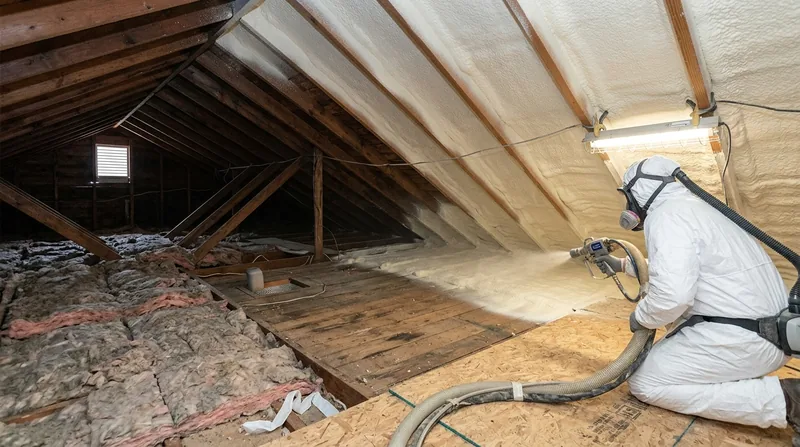




Insulation Replacement & Re-Insulation in Fort Smith is not a cosmetic upgrade, it is the foundation of a home's thermal envelope and humidity control in zone 3A. Fort Smith's housing stock spans Belle Grove's century-old crawl spaces and vented attics through mid-century ranches with settled fiberglass batts to newer two-story builds over garages and slabs. Across Sebastian and Crawford counties, the dominant failure mode is settled or displaced original insulation combined with air leakage through rim joists, band joists, and wall cavities. The Arkansas River Valley's high humidity and long cooling season mean that vented attics and crawl spaces pull in damp outside air, driving moisture inward through walls and raising indoor humidity and cooling costs. When old insulation fails, energy escapes and moisture enters. We remove the failed material and install closed cell or open cell foam, properly sealed and sized for the climate, restoring the air barrier and thermal resistance your home needs.
Why Insulation Replacement & Re-Insulation Matters in Fort Smith's Climate
Fort Smith's hot, humid summers and occasional winter cold snaps create competing pressures on insulation. Vented attics in older and mid-century homes allow moisture-laden outside air to enter, raising indoor humidity and forcing air conditioning to work harder. Settled fiberglass batts leave gaps that let convective air move through wall cavities. Crawl spaces with bare joists and band joists without foam act as thermal and moisture pathways into living spaces. The result is higher cooling bills, uncomfortable humidity, and accelerated decay of structural wood. Replacement with closed cell or open cell spray foam eliminates gaps, controls air movement, and stops moisture infiltration at the source.
- Settled or compressed batts in attics leave gaps that allow zone 3A humidity to move into wall cavities and living spaces.
- Vented crawl spaces and rim joists without foam insulation act as thermal bridges and moisture pathways that raise cooling load and indoor humidity.
- Original wall insulation in pre-1980 Fort Smith homes often consists of loose fill or thin batts that have settled or never sealed air leaks.
- Spray foam replacement stops air infiltration, reduces cooling and heating load, and controls humidity at the envelope boundary.
Replacing failed insulation is the most cost-effective way to restore comfort and lower energy cost in homes across Fort Smith, Greenwood, Van Buren, and Alma.
Key info: Fort Smith's building code and permitting requirements vary by city. Our attic work must comply with ventilation and thermal barrier rules set by your local building department. We help you understand what applies at your address and coordinate with your city's permit office. Always verify that any contractor you hire is prepared to pull permits and work under local inspection.
For detailed guidance on permits and building code requirements in your area, consult the Arkansas Building Commission or your city's building department directly.
How We Replace and Re-Insulate Homes in Fort Smith
Insulation replacement begins with removal of the failed material, whether settled fiberglass, loose fill, or degraded foam. We then seal air leaks at rim joists, band joists, rim board seams, and any visible gaps. We then apply closed cell or open cell foam to the specified thickness and R-value for your application, attic, wall, or crawl space. The foam cures under controlled conditions with mechanical ventilation, and we respect a re-entry window of 24 to 48 hours before occupants return. The result is a continuous air barrier, controlled humidity, and restored thermal resistance. This process applies to attics, walls, crawl spaces, and garages across Fort Smith and surrounding areas.
- We inspect the existing insulation, identify voids and air leaks, and confirm substrate condition (dry, clean, no active leaks).
- We remove old insulation and dispose of it responsibly, handling any hazardous materials per code.
- We seal air leaks at rim joists, band joists, rim board seams, electrical penetrations, and ductwork chases with foam or caulk.
- We apply closed cell or open cell foam to the thickness and R-value specified for your climate zone and application.
- We provide mechanical ventilation during cure and communicate the re-entry window to you in writing.
Every job includes a written estimate with R-value and thickness specifications so you know exactly what you are paying for.
Example: A mid-century ranch in Greenwood with a vented attic and settled R-19 batts over the entire floor. We remove the batts, air-seal the attic perimeter at the rim joist and band joist, then spray closed cell foam to R-30 or R-38 depending on your cooling load and budget. The sealed attic deck and foam-insulated rim joist eliminate the moisture pathway and reduce cooling cost. A crawl space retrofit follows the same sequence: remove old insulation, seal the rim, and apply foam to the band joist and rim board.
For more detail on our attic and crawl space approach, see our pages on attic spray foam insulation and crawl space spray foam insulation.
| Approach | Description | Best for |
|---|---|---|
| Closed Cell Spray Foam Replacement | High-density foam applied to 1.5 to 2 inches per pass, achieving R-6 to R-7 per inch, with vapor barrier properties and air sealing in one step. | Attics in hot climates, crawl spaces with humidity control needs, rim and band joists, metal buildings, and walls where condensation risk is high. |
| Open Cell Spray Foam Replacement | Lower-density foam applied to 3.5 to 5.5 inches per pass, achieving R-3.5 to R-4 per inch, with excellent air sealing and sound dampening, but requires a vapor retarder on the warm side in heating climates. | Attics where cost is primary and sound control is valued, interior wall cavities in conditioned spaces, and garages where condensation is less of a concern. |
| Wall and Injection Foam Retrofit | Closed cell foam injected into existing wall cavities of pre-1980 homes without removing drywall, filling voids left by settled batts or loose fill. | Pre-1980 Belle Grove and mid-century homes in Fort Smith with original wall cavities, minimal disruption to interior finishes, and no demolition. |
| Crawl Space and Band Joist Replacement | Closed cell foam applied to band joists, rim board, and foundation walls to R-15 to R-20, with sealed rim perimeter and controlled moisture entry. | All crawl space retrofits in zone 3A, especially homes with vented crawls, bare joists, or high indoor humidity and cooling bills. |
Insulation Replacement & Re-Insulation Cost in Fort Smith: What to Expect
Insulation replacement cost depends on the size of the area, the type of foam selected, the R-value target, and the condition of the substrate. A typical attic replacement in a Fort Smith ranch or two-story home runs from $2,800 to $6,500 depending on attic square footage, rim joist complexity, and whether closed cell or open cell foam is chosen. Crawl space band joist and rim board work typically ranges from $1,200 to $3,200 for a standard foundation perimeter. Wall injection retrofit in a pre-1980 home depends on cavity depth and wall square footage and typically runs $1,500 to $4,000 per wall section. Larger or multi-zone jobs, complex access, or jobs requiring substrate repair before foam application cost more. We provide a written estimate with R-value and thickness specs so you know the cost driver before we start.
The best approach is to get 2 to 3 estimates from contractors in Fort Smith and compare the R-value, thickness, foam type, and warranty language. A low estimate with no specs or warranty is a red flag. A reputable contractor will spend 30 to 45 minutes on site, ask about your comfort and energy concerns, and provide a written estimate with board-foot volume, foam type, R-value, and thickness clearly stated. Visit our pricing page for detailed pricing ranges and call us at (479) 415-0861 for a free, no-obligation estimate.
What to Look for When Hiring a Spray Foam Insulation Contractor Near Fort Smith
Choosing the right contractor for insulation replacement is as important as the material itself. A qualified contractor will provide a written estimate with R-value and thickness, explain the difference between closed cell and open cell foam for your application, answer questions about cure time and re-entry, and stand behind the work. Verify that the contractor is fully insured and carries liability and workers' compensation coverage. Ask for references from recent jobs in Fort Smith, Van Buren, or Greenwood and call them to confirm quality and timeline. Understand your local permitting requirements: some Fort Smith neighborhoods and HOAs have architectural review for exterior work, and crawl space and attic work may require a building permit depending on your zip code. Always verify that any contractor you hire is prepared to work under local inspection and coordinate with your building department.
- Request a written estimate with R-value, foam type, thickness, and board-foot volume clearly stated, never a price with no specs.
- Verify that the contractor is fully insured and carries workers' compensation, and ask to see a current certificate of insurance.
- Ask for at least two references from similar jobs completed in the last 12 months in Fort Smith or nearby areas.
- Confirm that the contractor will coordinate with your local building department and pull permits if required at your address.
- Understand the re-entry window (typically 24 to 48 hours) and mechanical ventilation requirements during cure, and get this in writing.
- Avoid estimates far below market, promises of lifetime warranties, or contractors who pressure you to book immediately without a site visit.
A local contractor with a Fort Smith address, local plates, and verifiable insurance is your best protection against rig-and-run crews or national franchises that disappear after the job. Contact us for a free estimate and references from Fort Smith homeowners we have worked for.
Insulation Replacement & Re-Insulation in Fort Smith: Pricing Guide
| Service | Price | Details |
|---|---|---|
| Attic Insulation Replacement | Starting at $2,800 | Includes removal of old insulation, air sealing at rim and band joists, and closed cell or open cell foam to R-30 or R-38 for typical 1,200 to 1,500 sq ft attic |
| Crawl Space Band Joist & Rim Board Replacement | Starting at $1,200 | Covers closed cell foam to rim board and band joist perimeter, sealed foundation rim, and moisture control for typical 1,000 to 1,200 linear feet |
| Wall Injection Foam Retrofit | Starting at $1,500 | Closed cell foam injected into existing wall cavities of pre-1980 homes without drywall removal, filled to R-15 or higher per cavity, priced per wall section |
| Multi-Zone or Complex Replacement | On estimate | Attic plus crawl space, multiple wall sections, or jobs requiring substrate repair or moisture remediation require on-site inspection before pricing |
| Travel and Estimates | Free estimate, no travel charge | Free written estimate with R-value and thickness specs included in Fort Smith and surrounding service area, response within 24 hours at (479) 415-0861 |
Indicative pricing, the exact cost depends on square footage, finish, and site access. Free personalized estimate within 24h at (479) 415-0861.


