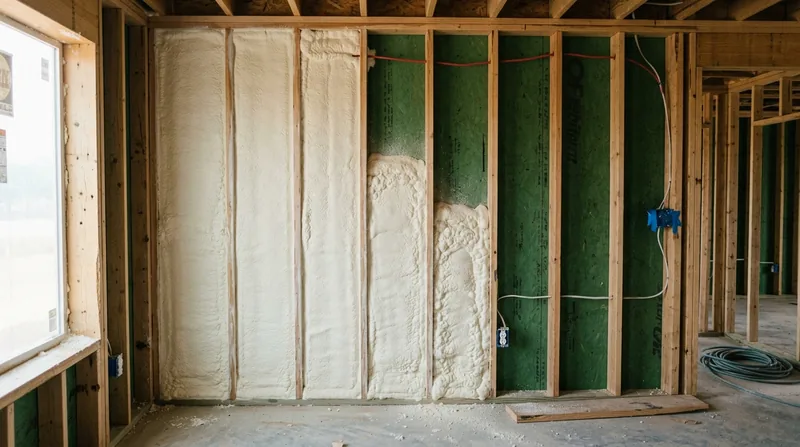




Commercial and new construction spray foam insulation in Fort Smith means planning thermal control into the building envelope before drywall closes walls and ceilings. New commercial shells and residential construction across Sebastian and Crawford counties, from Chaffee Crossing and Barling to Greenwood, benefit from foam specified at framing stage, when access is open and cost per board foot is lowest. We plan wall cavities, sealed roof decks, and slab-edge foam for new builds, and retrofit existing commercial space where energy loss through uninsulated walls and roofs drives cooling and heating costs. The Arkansas River Valley's hot, humid summers and occasional winter cold snaps put sustained load on mechanical systems; foam seals the building tight before occupancy, reducing strain on air conditioning and heating from day one.
Why Commercial and New Construction Spray Foam Matters in Fort Smith
New construction in Greater Fort Smith typically runs on tight schedules and fixed budgets. Spray foam applied before drywall closes the framing delivers continuous insulation and air sealing in a single step, eliminating gaps, thermal bridges, and the labor cost of taping seams on batts or blown-in fiberglass. For commercial buildings, warehouses, and new residential subdivisions, this efficiency translates to faster occupancy and lower energy baseline from the start. The region's high humidity and long cooling season mean uncontrolled air leakage through walls and roof decks costs money every month; sealed foam prevents that load before the building is even occupied.
- We measure wall, roof deck, and rim board cavities at framing stage and plan foam thickness and R-value to meet or exceed local building code.
- Closed cell spray foam on rim boards and slab edges stops thermal bridging and moisture entry that plagues Fort Smith's humid climate.
- Open cell foam in interior walls and sealed attics offers cost-effective insulation and sound dampening for commercial office and residential interiors.
- We coordinate with builders and general contractors to schedule foam application before drywall, electrical rough-in, or HVAC ductwork, keeping the timeline on track.
Sealing the building envelope during construction prevents the costly retrofit work that property owners in Fort Smith face years later when energy bills climb and humidity control fails.
Key info: New construction toward Chaffee Crossing and Greenwood often sits on slab with second-story rooms or mechanical space above the first floor. Spray foam on the rim board and slab edge stops the thermal leak that makes those upper rooms too hot in summer and cold during winter snaps. A sealed roof deck on a commercial shell in Van Buren or Alma prevents condensation on steel decking during the humid months and reduces attic temperature by 15 to 25 degrees.
For guidance on permits and code compliance at your specific address, contact your local building department. Attic ventilation, ignition barriers, and thermal barriers are governed by the energy and building code in force in your city, and the building official has final say on foam specifications.
How We Work with Builders and Commercial Contractors in Fort Smith
Our process begins at the framing stage, when we walk the building with the general contractor or builder, measure cavities and roof decks, and specify foam type, thickness, and R-value to meet the project's energy and code goals. We coordinate scheduling so foam is applied before drywall, mechanical systems, or other trades close the framing. On site, we set up equipment, control temperature and humidity during cure, and apply foam at the correct drum temperature and manufacturer ratio. Once cured, foam is ready for drywall, electrical, or the next trade, with no delays to the construction schedule.
- We schedule a site walk with the builder or contractor to review the building plan, identify foam locations, and confirm wall cavity depths and roof deck dimensions.
- We provide a written estimate with R-value, foam thickness, and board-foot coverage so the builder knows exact cost and thermal performance before work begins.
- We apply foam at the correct ratio and drum temperature, with mechanical ventilation during cure to control fume dispersion and meet safety and comfort standards.
- We document the job with photos and written notes so the builder and property owner have a record of what was installed and where.
This approach keeps the construction schedule on track and gives the builder and owner confidence in the building's thermal performance and code compliance from day one.
Local example: A new two-story residential subdivision in Barling with slab foundations and second-story rooms over garages. We foam the rim boards and slab edges (closed cell, 1.5 inches, R-9 minimum) to seal the thermal leak at the perimeter. The builder schedules us before drywall, we finish in a day or two depending on the number of units, and the framing is ready for the next trade. Homeowners move in to a tight, efficient building, and their cooling bills start 15 to 20 percent lower than a conventionally framed and insulated home in the same neighborhood.
For a closer look at how we seal air leaks and support energy performance, see our air sealing service page. We also handle closed cell spray foam insulation for moisture control and open cell spray foam for cost-effective interior insulation and sound dampening.
Spray Foam Methods and Applications for New Construction
| Approach | Description | Best for |
|---|---|---|
| Closed Cell Wall Cavities | High-density foam (3.5 to 4 lb/cu ft) sprayed into 2x4 or 2x6 cavities, fills completely, provides R-6 to R-7 per inch plus vapor barrier in one pass. | New construction walls where moisture control and high R-value per inch matter; exterior walls exposed to humidity and temperature swings. |
| Closed Cell Rim and Slab Edge | 1.5 to 2 inches of closed cell foam sprayed on rim boards and slab edges, stops thermal bridging and moisture infiltration at the building perimeter. | All new construction on slab or with crawl spaces; prevents condensation and reduces heating and cooling loss at the thermal weak point. |
| Sealed Roof Decks | Closed cell foam sprayed directly to steel or wood decking before roof assembly, creates unvented attic with continuous insulation and moisture control. | Commercial buildings, metal structures, and residential roofs where attic condensation is a risk; eliminates ventilation complexity. |
| Open Cell Interior Walls | Low-density foam (0.5 to 1.5 lb/cu ft) sprayed into interior walls and cavities, provides R-3.5 per inch, allows vapor transmission, reduces sound transmission. | Commercial office partitions, interior walls, and residential applications where cost and sound control matter more than vapor barrier function. |
| Slab-on-Grade Edge and Perimeter | Closed cell foam applied to the edge of slab-on-grade foundations before the concrete pour, or retrofitted to the exposed edge, insulates the perimeter and blocks moisture. | New commercial slabs, warehouses, and residential slabs in Fort Smith's humid climate where ground moisture and seasonal temperature swings affect indoor comfort. |
Commercial and New Construction Spray Foam Cost in Fort Smith: What to Expect
The cost of spray foam on a new construction project depends on the scope of foam application, the type of foam (closed cell or open cell), the building's size and complexity, and the R-value and thickness required by code. A free commercial estimate from Fort Smith Spray Foam Insulation includes a site walk, cavity measurements, and a written quote with R-value, thickness, and total board-foot cost so you and your builder know the exact price before work begins. Factors that affect cost include the linear feet of rim board or slab edge, the total square footage of walls and roof decks to be foamed, access for spray equipment, and the building's location within our service area.
For new residential construction, rim board and slab edge foam typically runs $1.50 to $3.00 per linear foot depending on foam type and thickness. Wall cavity foam in a new home costs more per board foot than rim work but delivers high R-value and air sealing in one pass. Commercial buildings with large roof decks or sealed attics run higher total cost but lower cost per square foot because of scale. Getting 2 to 3 estimates from different spray foam contractors gives you confidence in the market rate and helps you spot low-ball pricing that often signals cut corners on drum temperature, ratio, or ventilation during cure.
We provide written estimates with no obligation, and we respond within 24 hours to calls and inquiries at (479) 415-0861. For a detailed look at pricing across all our services, visit our pricing overview page.
What to Look for When Hiring a Spray Foam Insulation Contractor Near Fort Smith
Hiring the right spray foam contractor means verifying insurance, understanding the estimate, and checking that the installer follows best practices during application and cure. A legitimate spray foam contractor in Fort Smith carries full insurance and can provide a certificate of coverage on request. The estimate should include R-value, foam thickness, and the total board feet so you know exactly what you are paying for and can compare apples to apples with other bids. Ask the contractor how they control temperature and humidity during cure, what re-entry window they recommend (typically 24 to 48 hours), and whether they have references from recent jobs in Fort Smith or nearby cities.
- Verify that the contractor is fully insured and ask for a certificate of insurance that names you as additional insured if required by your general contractor or building owner.
- Ask for the written estimate to include R-value per inch, foam thickness, board-foot total, and the type of foam (closed cell or open cell) so you know what is being installed.
- Request references from at least two recent commercial or new construction projects in Fort Smith, Van Buren, or Greenwood, and call them to ask about quality, timeline, and post-job support.
- Confirm that the contractor uses mechanical ventilation during cure and will not promise immediate re-entry; proper cure time and ventilation are marks of professional work.
- Check that the estimate includes a clear price with no hidden fees, and ask what happens if the building has moisture, active leaks, or wet framing at the time of spray; a reputable contractor will walk away rather than spray over wet substrate.
Taking time to vet your spray foam contractor upfront prevents costly callbacks and ensures your new building starts life with a tight, efficient envelope. For a free estimate and to discuss your project with our team, contact us online or call (479) 415-0861.
Commercial & New Construction Spray Foam in Fort Smith: Pricing Guide
| Service | Price | Details |
|---|---|---|
| Free Commercial Estimate | Free | Site walk, cavity measurement, written quote with R-value and board-foot total included, no obligation to book |
| Rim Board and Slab Edge Foam | Starting at $1.50 to $3.00 per linear foot | Closed cell foam on rim boards and slab edges, sealed perimeter, varies by foam type and thickness specification |
| Wall Cavity Spray Foam | Starting at $0.80 to $1.50 per board foot | Closed or open cell foam in 2x4 or 2x6 wall cavities, price depends on cavity depth and foam density selected |
| Sealed Roof Deck and Attic Foam | Starting at $1.00 to $2.00 per board foot | Closed cell foam on roof decking or attic space, unvented assembly, price varies with deck size and foam thickness |
| Large Commercial or Complex Project | On estimate | Warehouse, multi-story building, or mixed-scope job requires site visit, plan review, and detailed calculation before quote |
| Travel and Scheduling | Included | No mileage fee or travel charge within Fort Smith and surrounding service areas, included in estimate |
Indicative pricing, the exact cost depends on square footage, finish, and site access. Free personalized estimate within 24h at (479) 415-0861.


