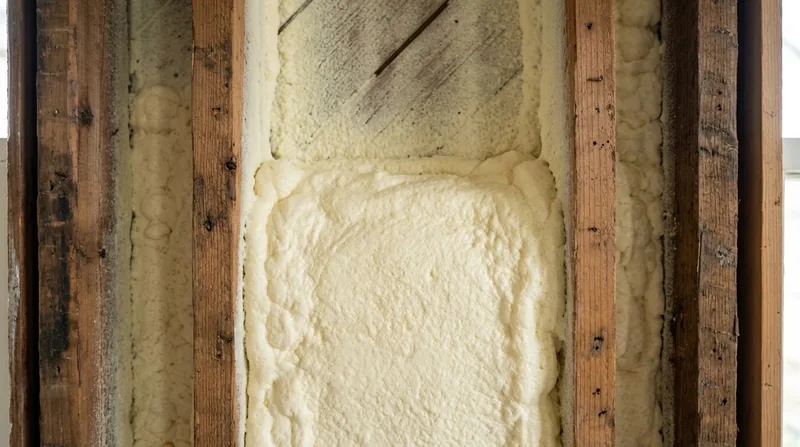




Open Cell Spray Foam Insulation in Fort Smith fills wall cavities and attic rafter bays with a soft, expanding foam that seals air leaks while dampening sound. Fort Smith's housing stock spans Belle Grove's historic homes with original wall cavities, mid-century ranches with settled fiberglass batts, and newer two-story construction where rooms over garages run hot in summer and cold in winter. The Arkansas River Valley sits in IECC climate zone 3A: hot, humid summers where moisture drives inward through vented attics and crawl spaces, straining air conditioning and pushing cooling bills higher. Open cell foam expands to fill irregular stud cavities and still-air-seals against that humidity without the density or cost of closed cell. We help Fort Smith homeowners and builders understand when open cell is the right answer and when a simpler, cheaper approach fits the job better.
Why Open Cell Spray Foam Matters in Fort Smith's Humid Climate
Fort Smith's cooling season runs long, and vented attics and crawl spaces pull in damp outside air year-round. Fiberglass batts settle flat and lose contact with framing, leaving air gaps. Older homes in Belle Grove have original wall cavities with no insulation at all. Open cell foam fills those gaps completely, stopping the convection that lets humid air circulate through walls and attics, which reduces the load on your air conditioner and keeps indoor humidity lower without adding the weight or cost of closed cell foam.
- Expands fully to fill stud cavities and irregular spaces in older Belle Grove homes and mid-century ranches.
- Seals air leaks that let humid summer air infiltrate through walls and attic framing.
- Absorbs sound better than closed cell, a real benefit in two-story homes over garages or near busy roads.
- Costs less per board foot than closed cell, making it the practical choice for attic top-ups and wall retrofits on a budget.
- Works as a secondary air barrier even after settling, holding its seal longer than blown-in fiberglass.
Getting the humidity right in Fort Smith's river valley climate is the single biggest driver of comfort and energy cost. Open cell foam addresses that directly.
Key info: Fort Smith homeowners who retrofit wall cavities in older homes with open cell foam typically see faster cooling response and lower humidity in summer, even before touching the attic. A Belle Grove bungalow with uninsulated 2x4 walls will cool 5 to 10 degrees faster once the walls are sealed.
For more detail on how spray foam seals and insulates together, see our air sealing service page.
How We Install Open Cell Spray Foam in Fort Smith Homes and Attics
Open cell foam is sprayed from a heated drum through a handheld applicator, expanding as it cures. We control the thickness on each pass to hit the R-value and board foot density your space needs. The foam cures in 24 to 48 hours, and we manage ventilation during that window so the smell does not linger in your home. Proper technique, correct drum temperature, and the manufacturer's ratio are what separate a solid installation from one that will off-gas or fail to cure properly.
- We inspect the space, check for moisture, leaks, or contamination, and walk away if the substrate is not dry.
- We set up mechanical ventilation to run during and after spraying, clearing VOCs as the foam cures.
- We spray the foam in controlled passes, measuring thickness and board feet as we go to hit the target R-value.
- We apply a thermal barrier (drywall, intumescent paint, or a code-approved membrane) where required by your local building code.
- We provide a written estimate with R-value, thickness, and board feet before we start, so you know exactly what you are getting.
The difference between a local, accountable shop and a rig-and-run outfit is visible in the estimate itself: we give you specs, they give you a price.
Real example: A Van Buren mid-century ranch with a vented attic had flat, settled fiberglass over the joists and no rim joist insulation. We sprayed 3.5 inches of open cell over the attic floor, sealing the rim joists and band board as well. Total was 480 board feet, cured in 36 hours with a box fan running in the attic. The homeowner reported a 12-degree drop in the master bedroom upstairs within the first week of summer.
For a deeper look at attic spray foam work, visit our attic insulation page.
Open Cell vs. Closed Cell: Which Is Right for Your Fort Smith Home?
Open cell and closed cell are different products for different jobs. Open cell is lower density, softer, and absorbs sound. It is the right choice for attics, walls, and garages where you want air sealing and cost control. Closed cell is denser, has a higher R-value per inch, and is vapor-impermeable, making it the choice for metal buildings, crawl spaces with moisture, and rim joists where condensation is a real risk. Fort Smith's humid climate means both products have a place.
| Approach | Description | Best for |
|---|---|---|
| Open Cell Spray Foam | Low-density, soft, sound-absorbing foam that expands to fill cavities and cures in 24-48 hours. | Attic top-ups, wall cavity retrofit, garage ceilings, and sound dampening in two-story homes. |
| Closed Cell Spray Foam | Higher-density, rigid foam with higher R-value per inch and vapor resistance, cures quickly. | Crawl spaces, rim joists, metal buildings, and areas where moisture control and structural rigidity matter. |
| Blown-In Fiberglass (When Appropriate) | Loose-fill insulation, no air seal, settles over time, lower cost per board foot. | Attic top-up over sound existing insulation when air sealing is not the priority and budget is tight. |
| Wall Injection Foam | Low-pressure injection into existing wall cavities through small holes, no demolition needed. | Retrofit of Belle Grove and older mid-century homes where walls are empty or have failed batts. |
Open cell is the smart choice when your priority is cost-effective air sealing and you do not need vapor resistance. Closed cell is the right call when moisture control or structural rigidity is the limiting factor. We help you choose based on what the space actually needs, not what has the highest margin.
Open Cell Spray Foam Insulation Cost in Fort Smith: What to Expect
Open cell spray foam starts at around $0.55 per board foot in the Fort Smith market, but the total cost depends on several real factors: the size of the space, how accessible it is, whether you are spraying an attic floor or filling wall cavities, and whether old insulation needs removal first. A 1,200-square-foot attic top-up might run 400 to 600 board feet. A wall retrofit in a Belle Grove home with 2x4 cavities and no existing insulation might be 200 to 400 board feet. Removal of failed fiberglass or old foam adds labor and disposal cost.
The best way to know your actual cost is to get written estimates from two or three contractors, each with board feet, R-value, and thickness spelled out. A contractor who gives you a price per square foot without seeing the space is guessing. We measure on site, give you a detailed estimate with specs, and charge for what we actually spray.
For a full pricing overview and to see how other services compare, visit our pricing page. If your job involves removing old insulation first, see our insulation removal service.
What to Look for When Hiring an Open Cell Spray Foam Contractor Near Fort Smith
The spray foam trade has two types of operators: local shops with a Fort Smith address and local insurance, and out-of-state rig-and-run outfits that spray in an afternoon and are unreachable when the smell will not go away. You can spot the difference in the estimate. A real contractor gives you R-value, thickness, and board feet in writing. They show proof of insurance. They explain the cure time and re-entry window. They do not promise overnight results or 50% energy savings. They answer your questions without pressure.
- Ask for a written estimate with R-value, thickness in inches, and total board feet, never just a price per square foot.
- Verify the contractor is fully insured and ask for a certificate of insurance naming your address as additional insured.
- Check references from Fort Smith, Van Buren, or Greenwood jobs completed in the last two years, and call them.
- Understand what your local building department requires: thermal barriers, ignition barriers, and ventilation rules vary by city and ZIP code.
- Ask whether the contractor pulls permits or whether you do, and get that in writing.
- If your home is in an HOA, confirm that spray foam on the exterior (rim joists, band board) or any metal building work complies with architectural rules.
A contractor who walks you through these steps is one you can trust. One who skips them is one to skip.
Ready to get a free estimate? Contact us or call (479) 415-0861. We respond within 24 hours and there is no obligation to book.
Open Cell Spray Foam Insulation in Fort Smith: Pricing Guide
| Service | Price | Details |
|---|---|---|
| Open Cell Spray Foam (Attic or Wall) | Starting at $0.55/board ft | Price moves up with removal of old insulation, difficult access, or custom thermal barrier application required by code |
| Attic Top-Up (Existing Sound Insulation) | Starting at $0.55/board ft | Typical 400 to 600 board feet depending on attic floor area and target R-value over existing batts |
| Wall Cavity Retrofit (Belle Grove or Mid-Century Home) | Starting at $0.60/board ft | Injection or spray into empty 2x4 or 2x6 cavities, includes access holes and patching, 200 to 400 board feet typical |
| Insulation Removal Plus Open Cell Spray | On estimate | Removal labor and disposal cost added to spray cost; on-site inspection required to quote removal separately |
| Free Written Estimate | No charge | Response within 24 hours, includes board feet, R-value, thickness, and thermal barrier requirements for your address |
Indicative pricing, the exact cost depends on square footage, finish, and site access. Free personalized estimate within 24h at (479) 415-0861.


