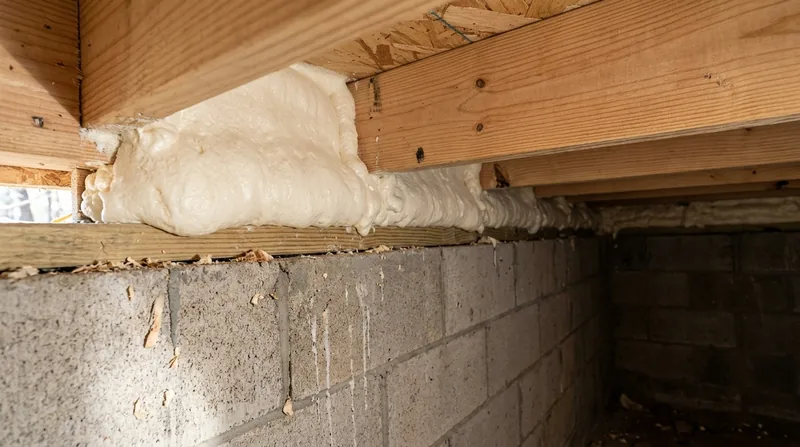




Rim Joist & Band Joist Spray Foam in Fort Smith seals the thermal leak that runs around your foundation's perimeter, cutting the draft path that pulls cold air through crawl spaces and slab-edge framing across Sebastian County. Winter cold snaps and ice storms expose this weak point fast: the band joist line is where heated air escapes and outside moisture works its way into wall cavities. In Fort Smith's climate, the rim joist is often the last uninsulated framing detail left standing after an attic upgrade, and it accounts for measurable heating loss during the mild but persistent cold of Arkansas winters. We spray and seal this junction with closed cell or open cell foam, stopping the convection loop that runs through vented crawl spaces and uninsulated rim cavities. The result is lower winter heating bills, warmer floors over crawl spaces, and a tighter envelope that reduces the strain on your air conditioning during Fort Smith's long, humid cooling season.
Why Rim Joist & Band Joist Sealing Matters in Fort Smith's River Valley Homes
The Belle Grove historic district and mid-century ranch neighborhoods across Sebastian County sit on crawl spaces and slabs where the band joist was never built with today's insulation standards in mind. Vented crawl spaces pull in humid outside air, and the rim joist framing that sits above them becomes a direct thermal bridge to the conditioned space. In winter, this framing loses heat faster than any other boundary, and in summer, moisture-laden air infiltrates through the same path, raising indoor humidity and forcing your air conditioning to work harder. The Arkansas River Valley's high humidity most of the year means that air sealing the rim joist is not just a comfort upgrade, it is a moisture control strategy.
- Rim joists account for 10 to 15 percent of total heat loss in homes with crawl spaces or slab-on-grade construction.
- Uninsulated band joists create cold floors over crawl spaces and drafty basement walls in Fort Smith's older stock.
- Sealing the rim joist stops the air pathway that allows humid outside air to enter wall cavities and attic spaces.
- Closed cell foam on the rim joist also acts as a vapor barrier, reducing moisture migration into the band joist framing itself.
- A tight rim joist line reduces the load on heating and cooling systems during Fort Smith's heating snaps and cooling season.
Addressing the rim joist is often the most cost-effective single-point air sealing improvement available to homeowners in Van Buren, Alma, and Greenwood.
Key info: Fort Smith's building department governs insulation installation standards, ignition barriers, and thermal barriers under the energy and building code in force at your address. Always verify permit requirements for your specific property before work begins. Contact Fort Smith's building and code enforcement office to confirm what applies to your rim joist sealing project.
How We Seal Your Rim Joist & Band Joist: Step-by-Step Process
Rim joist sealing starts with a clear assessment of what is already there: existing fiberglass, bare framing, moisture damage, or failed foam from a previous retrofit. We inspect the band joist line, check for active moisture or water intrusion, and measure the cavity depth. If we find wet substrate or active leaks, we stop and refer you to the right specialist, foam over wet wood is a recipe for mold and framing rot. Once the substrate is confirmed dry, we apply spray foam to the full depth of the rim cavity, controlling thickness per pass to ensure proper cure and maximum R-value. For crawl spaces, we typically use closed cell foam because of its superior moisture resistance and vapor permeability; for rim joists in garages or over vented attics, open cell is often the right choice at lower cost.
- We inspect the rim joist cavity, check for moisture, existing insulation, and structural condition.
- We seal any gaps or cracks in the rim framing with low-expansion foam to create a uniform substrate.
- We apply closed cell or open cell spray foam to the full depth of the rim cavity in controlled passes.
- We verify thickness and R-value against manufacturer specs and your estimate before moving to the next section.
- We allow 24 to 48 hours cure time before the space is re-entered or covered.
- We air-seal any remaining penetrations around band joist edges, sill plates, and transitions to adjacent cavities.
The entire rim joist line around your foundation is treated as one continuous thermal boundary, not a patchwork of separate sections.
Example: A Fort Smith ranch home in the Barling area with a 1,200 square foot crawl space footprint typically has 200 to 240 linear feet of rim joist framing. At 16 inches of cavity depth and 2 inches of closed cell foam, that job takes one full day and yields an R-value of 12 to 14, plus the air sealing benefit that cuts infiltration at the foundation perimeter by 80 to 90 percent.
For more detail on how spray foam air sealing works across your entire envelope, see our air sealing service page.
Rim Joist Sealing Methods: Closed Cell vs. Open Cell
| Approach | Description | Best for |
|---|---|---|
| Closed Cell Spray Foam | High-density foam (3.5 to 3.6 lbs/cubic foot) that cures rigid and acts as a vapor barrier. R-value of 6 to 6.5 per inch. Resists moisture and air infiltration. | Rim joists in crawl spaces, slab-edge framing where moisture is a concern, and foundations below grade or near the water table. |
| Open Cell Spray Foam | Lower-density foam (0.5 to 0.6 lbs/cubic foot) that cures soft and vapor-permeable. R-value of 3.5 to 3.8 per inch. Lower material cost. | Rim joists in garages, above-grade band joists with no moisture risk, and situations where cost is the primary driver and vapor transmission is acceptable. |
| Rim Joist Retrofit over Old Fiberglass | Removal of failed or settled batts, then spray foam application to the clean cavity. May require supplemental framing or blocking if the original cavity is irregular. | Mid-century homes in Fort Smith where original fiberglass has settled flat or is wet and no longer performing. |
| Rim Joist Air Sealing without Full Foam | Low-expansion foam or caulk applied to seal gaps, cracks, and rim cavity edges while leaving the main cavity uninsulated. Provides air sealing benefit with minimal material cost. | Homes where the primary goal is infiltration control and existing insulation is acceptable, or budgets are limited to the most critical air pathways. |
Rim Joist & Band Joist Spray Foam Cost in Fort Smith: What to Expect
Rim joist and band joist spray foam in Fort Smith starts at around $650 to $900 for a typical single-story home with 200 to 240 linear feet of rim framing. The final cost depends on cavity depth, whether existing insulation must be removed, accessibility (crawl space height, rim joist location), and the foam type (closed cell costs more than open cell but offers superior moisture resistance). A two-story home in Greenwood or Barling with a larger footprint and more linear footage of rim joist will run higher. Travel is included in our service area, which covers Fort Smith, Van Buren, Alma, and surrounding cities in Sebastian and Crawford counties.
What moves the price up or down:
- Cavity depth: Shallower rim joists (6 to 8 inches) cost less to foam than deeper cavities (12 to 16 inches).
- Existing insulation removal: If old fiberglass or foam must be pulled out first, add labor and disposal.
- Crawl space access: Low crawl spaces or blocked access increase labor time and equipment setup.
- Closed cell vs. open cell: Closed cell foam is 40 to 60 percent more expensive per board foot but adds vapor barrier protection.
- Moisture remediation: If the rim joist is wet or shows mold, we stop and refer you to a moisture specialist before foam goes on.
We provide written estimates with R-value, thickness, and linear footage specified so you know exactly what you are paying for. See our full pricing page for more detail on cost factors and financing options.
Rim Joist & Band Joist Spray Foam Near Me: What Fort Smith Homeowners Should Know When Hiring
Choosing the right spray foam contractor for your rim joist sealing is as important as choosing the right foam type. The spray foam trade includes rig-and-run crews from out of state who spray a job in an afternoon and disappear, national franchise operations with high overhead, and local independents with a local address and local accountability. The honest differentiator is how a contractor handles estimates, permits, and the cure window. Here is what to verify before you hire anyone, including us.
- Ask for a written estimate that includes R-value per inch, total thickness in inches, linear footage, and the foam type (closed cell or open cell).
- Verify the contractor is fully insured and ask for a certificate of insurance naming your address as a certificate holder.
- Check references from recent projects in Fort Smith or Van Buren, and call them to ask about cure time, odor, and follow-up service.
- Confirm whether the contractor will help you navigate permit requirements for your city or county, or whether you are responsible for pulling permits yourself.
- Ask about the cure window and re-entry time: any contractor promising immediate re-entry or same-day occupancy is cutting corners on ventilation or temperature control.
- Verify that the contractor will inspect the rim joist substrate before spraying and will walk away if moisture or rot is present.
If you have questions about what applies to your specific property in Fort Smith, Greenwood, Alma, or any of our service areas, contact us for a free estimate. We respond within 24 hours and will walk you through the entire process, including permitting and what to expect after we leave.
Rim Joist & Band Joist Spray Foam in Fort Smith: Pricing Guide
| Service | Price | Details |
|---|---|---|
| Single-story home rim joist sealing | Starting at $650 | 200 to 240 linear feet of rim framing, open cell foam, typical crawl space depth, no removal required |
| Closed cell rim joist sealing (moisture protection) | Starting at $900 | Same square footage as above but with closed cell foam for vapor barrier protection and superior moisture resistance in crawl spaces |
| Rim joist retrofit with existing insulation removal | Starting at $800 | Includes removal and disposal of failed fiberglass or old foam, substrate preparation, then new spray foam application to full cavity depth |
| Two-story home or large foundation perimeter | On estimate | Larger footprint and more linear footage of rim joist requires on-site measurement to provide accurate pricing and material breakdown |
| Travel and setup | Included | No separate mileage fee or travel charge in Fort Smith and surrounding Sebastian, Crawford, Washington, Logan, Franklin and Scott counties |
| Free estimate | No obligation | Response within 24 hours at (479) 415-0861, includes site inspection, R-value and thickness specifications, and written proposal |
Indicative pricing, the exact cost depends on square footage, finish, and site access. Free personalized estimate within 24h at (479) 415-0861.


