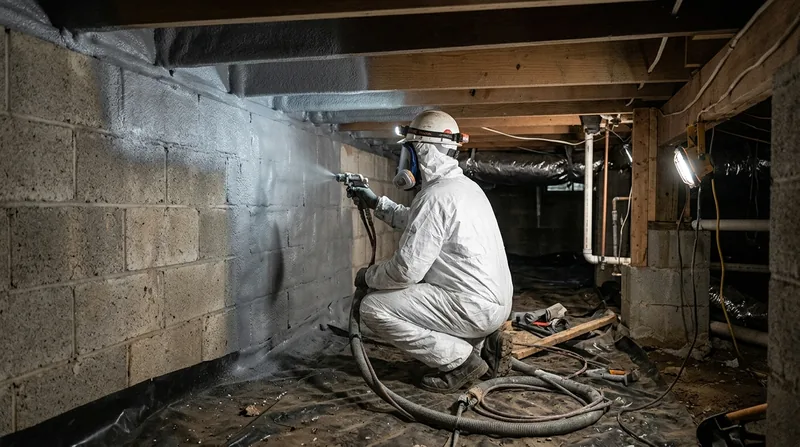




Closed cell spray foam insulation in Fort Smith addresses the core energy problem of the Arkansas River Valley: humidity driven inward through walls and attics during the long cooling season, combined with heat loss through crawl spaces and rim joists when winter cold snaps arrive. Fort Smith's mix of older Belle Grove homes with ventilated crawl spaces, mid-century ranches with settled fiberglass batts, and newer two-story construction all face the same challenge. Closed cell foam adds both rigidity and a vapor retarder where open-cell foam would allow moisture to pass through. We apply it in controlled passes to rim joists, crawl space walls, block foundations, and sealed attics across Sebastian and Crawford counties, tracking substrate temperature for a solid cure. The result is tighter building envelope performance and lower humidity year-round.
Why Closed Cell Spray Foam Matters in Fort Smith's Hot, Humid Climate
Fort Smith sits in IECC climate zone 3A, where summer humidity stays high most of the year and moisture drives inward through every gap in the building envelope. Vented attics and crawl spaces pull in damp outside air that raises indoor humidity and strains air conditioning. Rim joists and band joists around crawl spaces are the first path moisture takes into walls and framing. Closed cell foam stops that inward drive with a continuous vapor retarder, and its higher density adds structural support to block foundations and crawl space walls under load.
- Closed cell foam carries an R-value of 6.0 to 6.5 per inch, delivering high performance in thin profiles where space is tight.
- The foam's rigidity reinforces crawl space walls and block foundations against lateral pressure and settling.
- A continuous vapor retarder stops humid air from entering walls and attics, cutting the load on air conditioning during cooling season.
- Closed cell foam cures to a water-resistant surface, protecting against seasonal moisture infiltration in crawl spaces and rim joist zones.
Controlling humidity is the single biggest driver of energy cost across Greater Fort Smith, and closed cell foam is the direct answer to that problem.
Key info: A mid-century ranch in Van Buren with a vented crawl space and bare floor joists loses 20 to 30 percent of conditioned air to that crawl space alone. Closed cell foam on rim joists and band joists, paired with air sealing, cuts that loss by half and lowers cooling bills by 15 to 25 percent in the first summer.
For more information on how to verify any spray foam contractor's insurance and credentials, visit the Arkansas State Board of Contractors or your local city building department website.
How We Install Closed Cell Spray Foam in Fort Smith Crawl Spaces and Attics
Closed cell foam requires precision from the first pass. We start with a site assessment to measure substrate temperature, check for active moisture, and confirm the foam will cure properly. Substrate temperature must be within the manufacturer's range, typically 50 to 90 degrees Fahrenheit. We then spray in controlled passes, tracking thickness and ratio to ensure a solid, uniform cure. Mechanical ventilation runs during application and cure, and we enforce a stated re-entry window of 24 to 48 hours before the space is occupied.
- We inspect the crawl space, rim joist, or attic zone for active leaks, standing water, or wet substrate, and we do not spray if conditions are not right.
- We measure and document substrate temperature, confirming it falls within the manufacturer's safe range for cure.
- We apply closed cell foam in controlled passes, maintaining the drum temperature and pump ratio specified by the manufacturer.
- We run mechanical ventilation during application and the full cure window to manage vapor and odor.
- We document the thickness and R-value of each zone and provide a written estimate with those specifications before work begins.
This step-by-step discipline is what separates a lasting installation from a job that smells for months and fails to cure properly.
Local example: A two-story home in Greenwood with a garage and rooms overhead had a vented attic where heat soaked the second floor in summer. The rim joist around the garage rim was uninsulated, and the crawl space below the main floor was pulling in humid air. We sealed the rim joist with two inches of closed cell foam, then sprayed the crawl space walls. The homeowner reported cooler upstairs rooms within two weeks and lower humidity readings in the crawl space by the end of the cooling season.
For details on how closed cell foam pairs with air sealing work, see our air sealing service page.
Closed Cell Spray Foam Methods and Applications
| Application | Description | Best For |
|---|---|---|
| Rim Joist and Band Joist Sealing | Two to three inches of closed cell foam applied to the rim band where the house frame sits on the foundation, stopping air and moisture infiltration. | Homes in Fort Smith and Van Buren with crawl spaces or partial basements where humidity and cold drafts enter through the rim. |
| Crawl Space Wall Insulation | Closed cell foam sprayed directly onto block or concrete walls to create a continuous vapor retarder and air seal, protecting the foundation and floor framing above. | Sebastian and Crawford County homes with vented crawl spaces that pull in humid air during summer and cold air in winter. |
| Sealed Attic Roof Deck Spray | Closed cell foam applied directly to the underside of the roof sheathing in a sealed attic, creating an unvented, conditioned attic space that reduces cooling load. | New construction and retrofits where the attic will be part of the conditioned envelope, especially homes with rooms over garages or second-story zones that run hot. |
| Metal Building and Pole Barn Condensation Control | Closed cell foam sprayed on the inside of metal roof and wall panels to stop condensation on steel and provide thermal break and vapor control. | Metal buildings, barndominiums, and agricultural structures in Greater Fort Smith where steel panels sweat in humid conditions. |
| Block Foundation Injection and Cavity Fill | Closed cell foam injected into hollow block cavities or applied as a surface layer to reinforce foundation walls and block moisture and air entry. | Older Belle Grove and mid-century homes where block foundations were never insulated and are the primary source of moisture and energy loss. |
Closed Cell Spray Foam Insulation Cost in Fort Smith: What to Expect
Closed cell spray foam pricing starts at approximately $1.20 per board foot in the Fort Smith area, with most rim joist and crawl space jobs running $1.20 to $2.00 per board foot depending on access, substrate condition, and thickness required. A typical rim joist seal on a 1,500-square-foot home runs 80 to 120 board feet and costs $1,200 to $2,400 before any air sealing add-ons. Crawl space wall insulation on a full foundation can range from $2,000 to $5,000 depending on square footage and whether the space requires moisture prep work first. Sealed attic roof deck spray on a 2,000-square-foot home with a 6-inch target thickness runs 4,000 to 5,000 board feet and typically costs $5,000 to $8,000.
Several factors move the price within and above those ranges. Substrate temperature below 50 degrees or above 90 degrees requires warming equipment or a delay until conditions improve, adding cost. Crawl spaces with standing water or active leaks must be addressed before foam is applied, and that work is separate. Block foundations with deteriorated mortar or spalling may need repair before foam goes on. Access difficulty, such as a crawl space with limited headroom or a rim joist buried behind siding and soffit, increases labor time. Metal buildings with wide spans or complex roof lines require more material and time. A sealed attic with existing fiberglass batts requires removal and disposal first, which adds $500 to $2,000 depending on volume.
The best way to understand your actual cost is to request a free on-site estimate. We measure the square footage, check substrate conditions, and confirm what thickness and coverage you need. We then provide a written estimate with R-value and thickness specifications so you know exactly what you are paying for. For a detailed pricing breakdown by service type, see our full pricing overview.
What to Look for When Hiring a Spray Foam Insulation Contractor Near Fort Smith
Hiring the right spray foam contractor is the difference between a job that performs for decades and one that smells for months or fails to cure. The spray foam trade includes rig-and-run crews working out of out-of-state trailers, national franchises with variable quality, and local independents. The local independent with a local address and local plates is positioned to stand behind the work and be reachable when questions arise. When you are evaluating any contractor, including us, verify insurance and credentials directly, not through a website claim alone.
- Request a written estimate that includes R-value per inch, target thickness for each zone, and the board footage being sprayed.
- Ask the contractor to explain how substrate temperature will be managed and what mechanical ventilation will run during cure.
- Verify that the contractor is fully insured and ask for a certificate of insurance naming your address as additional insured.
- Check references from at least two similar jobs in Fort Smith or Van Buren, and ask those homeowners about odor control, cure time, and whether the contractor was reachable after the job.
- Confirm that the contractor understands local permitting requirements for your address and will help you navigate what applies, even if permits are not required.
- Avoid any estimate with no R-value, no thickness specification, or a price far below market, and avoid any contractor who promises immediate re-entry.
Getting two or three estimates from different contractors is the standard practice and the smartest investment you can make before committing to a job. Contact us for a free estimate and we will walk you through the entire process, answer your questions, and let you compare our approach with others in the market.
Closed Cell Spray Foam Insulation in Fort Smith: Pricing Guide
| Service | Price | Details |
|---|---|---|
| Rim Joist and Band Joist Sealing | Starting at $1.20/board ft | Two to three inches on rim band, includes air sealing; access difficulty and substrate condition affect final cost |
| Crawl Space Wall Insulation | Starting at $1.40/board ft | Full foundation wall coverage; pricing increases with depth, moisture prep needs, and access limitations in confined spaces |
| Sealed Attic Roof Deck Spray | Starting at $1.50/board ft | Six-inch target thickness; cost rises if existing insulation removal is needed or attic access is restricted |
| Metal Building and Pole Barn Interior Spray | Starting at $1.30/board ft | Roof and wall panels; larger spans and complex geometries require on-site measure for accurate board footage |
| Travel and Setup | Included | No separate mileage fee or mobilization charge within Fort Smith and all surrounding service areas |
| Free Estimate | No cost | Written proposal with R-value and thickness specs; response within 24 hours, call (479) 415-0861 |
Indicative pricing, the exact cost depends on square footage, finish, and site access. Free personalized estimate within 24h at (479) 415-0861.


