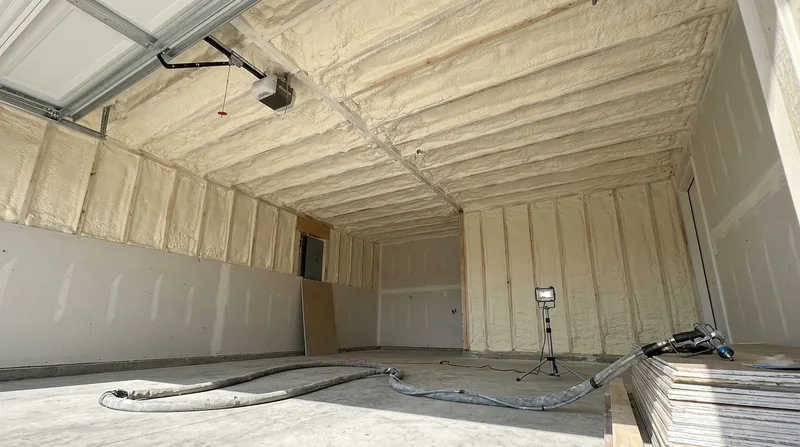




Rooms over garages in newer Fort Smith subdivisions like those pushing toward Chaffee Crossing, Barling, and Greenwood run hot in summer and cold during winter cold snaps. These two-story homes sit on slabs with living space directly above the garage, and the uninsulated garage ceiling becomes a thermal highway. In zone 3A, where hot, humid summers drive moisture inward and winter ice storms drop temperatures fast, an uninsulated garage ceiling or wall lets conditioned air escape and outside temperature in. Garage spray foam insulation in Fort Smith closes that air gap, seals the rim and band joists that frame the room above, and stops the temperature swing that forces your air conditioning and heating to work overtime. We foam garage walls, ceilings, and the band joists that connect the room above, delivering R-value where fiberglass batts or blown-in cellulose would leave gaps and air leaks. The result is a conditioned room that stays livable year-round without fighting the garage temperature on the other side of the wall. Our approach is straightforward: we measure the space on site, specify R-value and foam thickness in writing, and deliver an estimate with no surprises.
Why Garage Insulation Matters in Fort Smith and Sebastian County
The Fort Smith area spans three distinct housing eras, and newer subdivisions in Barling, Greenwood, and around Chaffee Crossing have brought two-story construction with rooms directly over garages. These homes were built to code, but code minimum is not comfort. Garages are vented or semi-conditioned spaces, and when a bedroom or home office sits directly above one, the uninsulated or poorly insulated ceiling becomes the thermal weak point. In summer, the garage heats up to 110 to 120 degrees, and that heat radiates into the room above. In winter, a cold snap can drop the garage to 30 degrees or lower, and the uninsulated ceiling acts as a cold sink. The Arkansas River Valley's long cooling season and sudden winter temperature swings mean homeowners feel this imbalance every month.
- Spray foam seals the air gap between the garage and the room above, stopping heat transfer and drafts that fiberglass batts cannot match.
- Closed cell foam provides structural rigidity and moisture resistance on garage walls and ceilings where humidity and temperature swings are extreme.
- Open cell foam in garage ceilings offers R-value at a lower cost when moisture control is not the primary concern.
- Band joists and rim joists around the garage perimeter are often overlooked, but sealing them with spray foam cuts the air leak that lets conditioned air escape into the unconditioned garage.
- An insulated garage ceiling also reduces noise from the garage into the room above, a benefit many homeowners do not anticipate.
Proper garage insulation is especially critical in newer Fort Smith homes where the room above is occupied full time and energy bills are highest during the season when the temperature difference is greatest.
Local example: A new construction home in Chaffee Crossing with a master bedroom over an attached garage will see that bedroom lose or gain 5 to 8 degrees of temperature difference from an uninsulated ceiling during peak summer or a winter cold snap. Foam insulation closes that gap and brings the room into the conditioned envelope.
For permitting and building code compliance in Fort Smith, check with the Fort Smith Planning and Development Services office to confirm thermal barrier and ignition barrier requirements for spray foam in your garage. Code requirements vary by address and building official.
How We Insulate Garage Ceilings and Walls in Fort Smith
Our process starts with a site visit and measurement. We assess the garage ceiling, walls, and band joists, identify air gaps and thermal bridges, and determine whether closed cell or open cell foam is the right fit for your climate and use. Closed cell foam is denser, provides higher R-value per inch, and resists moisture better in garages where humidity and temperature swings are extreme. Open cell foam is lighter and more cost-effective for garage ceilings where moisture control is less critical. We then prepare the substrate, ensuring it is clean and dry, set up ventilation to manage cure vapors, and spray the foam in controlled passes. Each pass is measured for thickness and coverage. Once cured, the foam is cut flush with the framing, and any exposed surfaces receive a thermal or ignition barrier as required by code.
- We schedule a free on-site estimate and walk you through R-value, thickness, and the specific foam type we recommend for your garage.
- We prepare the garage by removing any obstacles and protecting areas that should not be foamed, including HVAC equipment, electrical panels, and stored items.
- We spray the ceiling, walls, and band joists in measured passes, controlling thickness per pass to ensure proper cure and structural integrity.
- We ventilate the space during cure to manage off-gassing and maintain air quality, with a re-entry window of 24 to 48 hours depending on foam type and ambient conditions.
- We trim excess foam and apply thermal or ignition barrier where code requires, leaving the space ready for drywall, paint, or other finishing.
The entire process typically takes one to three days depending on garage size and complexity. We coordinate with you on scheduling and timing to minimize disruption to your home.
Fort Smith example: A two-car garage ceiling in a Greenwood subdivision measures 400 square feet. We foam the entire ceiling with 3.5 inches of closed cell foam (R-21), seal the band joists and rim joists at the perimeter, and apply a thermal barrier. The job takes two days. The homeowner re-enters after 48 hours and has a fully insulated garage ceiling that stops heat transfer and reduces noise from the garage into the bedroom above.
For a detailed look at how we approach similar jobs across the region, see our air sealing service page, which covers the band joist and rim joist work that complements garage ceiling insulation.
Garage Spray Foam Insulation Methods and Approaches
| Approach | Description | Best For |
|---|---|---|
| Closed Cell Spray Foam | Dense, high R-value per inch (R-6 to R-7 per inch), moisture resistant, structural support, typically 2 to 3.5 inches thick for garage ceilings. | Garage ceilings and walls where moisture and temperature swings are extreme, band joists, and rooms over garages in zone 3A. |
| Open Cell Spray Foam | Lighter density, R-3.5 to R-4 per inch, vapor permeable, sound dampening, typically 5.5 to 7 inches for equivalent R-value, lower cost per board foot. | Garage ceilings in detached garages or where noise reduction is a priority, and cost sensitivity is high. |
| Closed Cell on Exterior Garage Walls | Closed cell foam applied to exterior-facing garage walls, often 2 to 3 inches, provides thermal break and moisture barrier on the wall cavity. | Attached garages where the exterior wall is part of the conditioned envelope, and moisture intrusion is a risk in humid climates. |
| Band Joist and Rim Joist Foam | Closed cell foam injected or sprayed into the band joist cavity at the top of the garage wall framing, sealing the air gap between the garage and the room above. | All garages in Fort Smith, especially attached garages with living space above, to eliminate the primary air leak and thermal bridge. |
Garage Spray Foam Insulation Cost in Fort Smith: What to Expect
Garage spray foam insulation in Fort Smith typically starts at $1,200 for a single-car garage ceiling and scales with square footage, foam type, and complexity. A two-car garage ceiling with full band joist sealing runs higher, often in the $2,000 to $3,500 range depending on thickness, R-value, and whether walls are also foamed. Several factors move the cost up or down: the size of the garage (single-car versus two-car versus three-car), whether you are foaming the ceiling only or also the exterior walls and band joists, the foam type (closed cell is denser and higher R-value but costs more per board foot than open cell), and the condition of the substrate (if we need to remove old insulation or repair damaged framing, that adds time and material). Access also matters. A garage with high ceilings or complex framing takes longer to spray than a straightforward flat ceiling. Thickness specification is critical. Closed cell foam at 3.5 inches delivers R-21; open cell at 7 inches delivers approximately R-24. We always provide a written estimate with R-value and thickness specified so you know exactly what you are paying for.
We recommend getting two or three estimates from local contractors so you can compare R-value, thickness, foam type, and warranty. An estimate that quotes a price per square foot without specifying R-value and thickness is a red flag. Our estimates are free and come with no obligation to book.
For a full breakdown of pricing across all our services, visit our pricing page.
Garage Spray Foam Insulation Near Me: What Fort Smith Homeowners Should Know When Hiring
Hiring the right contractor for garage spray foam insulation is as important as the foam itself. The spray foam trade has two extremes: rig-and-run crews from out of state who spray a job in an afternoon and disappear when the smell lingers, and national franchises that promise everything and take weeks to show up. A local contractor with a local address and local accountability sits in the middle and is often the better choice. When evaluating any contractor, including ours, verify that they are fully insured and ask to see proof of coverage. Request references from recent garage insulation jobs in Fort Smith or nearby towns like Barling, Greenwood, or Van Buren, and call them. Ask whether the contractor provides a written estimate with R-value and thickness specified. If they quote a price per square foot without specifying those details, walk away. Ask about the re-entry window after foam cure. A contractor promising immediate re-entry or same-day occupancy is cutting corners on cure time. Check whether the contractor understands local code requirements for thermal and ignition barriers in your city. Fort Smith, Barling, Greenwood, and other cities in the area have different permitting and code enforcement, so verify that the contractor is familiar with your specific address and local building department. Finally, ask whether the contractor will help you navigate what permits apply at your address. We do; many do not.
- Request a written estimate with R-value, thickness, and foam type clearly specified so you can compare apples to apples with other contractors.
- Verify the contractor is fully insured and ask for a copy of their certificate of insurance before work begins.
- Ask for references from recent garage insulation jobs in Fort Smith or the surrounding area, and actually call them.
- Confirm the contractor understands local code requirements for thermal barriers, ignition barriers, and ventilation during cure in your city.
- Avoid contractors who promise immediate re-entry, same-day occupancy, or cure times shorter than 24 hours after spray application.
- Ask whether the contractor helps you understand what permits apply at your address and will coordinate with the local building department if needed.
When you are ready to move forward, contact us for a free estimate or call (479) 415-0861. We provide written estimates within 24 hours, specify R-value and thickness in writing, and coordinate with the local building department to confirm what applies at your address.
Related Insulation Services for Fort Smith Homes
Garage insulation is often part of a larger strategy to improve home comfort and energy efficiency. If your garage is attached to your home, insulating the garage ceiling and band joists works best when combined with attic insulation and air sealing in the living spaces above. Many Fort Smith homeowners also find that sealing crawl spaces and rim joists reduces the overall air leakage that forces heating and cooling systems to work harder. For homes with older fiberglass insulation that has settled or failed, we also offer insulation removal and replacement services. If you are building new or renovating, our new construction and commercial spray foam services cover the full scope of foam insulation and air sealing from the foundation up.
Garage Spray Foam Insulation in Fort Smith: Pricing Guide
| Service | Price | Details |
|---|---|---|
| Single-car garage ceiling | Starting at $1,200 | Closed cell foam, full ceiling coverage, 3 to 3.5 inches, R-value 18 to 21, includes band joist sealing |
| Two-car garage ceiling with band joist sealing | Starting at $2,000 | Closed cell foam, 3.5 inches, full perimeter rim and band joist sealing, R-value 21, thermal barrier application |
| Garage ceiling plus exterior wall insulation | Starting at $2,800 | Closed cell foam on ceiling and exterior-facing walls, 2 to 3 inches, band joist sealing, moisture barrier for attached garages |
| Open cell garage ceiling (cost-effective option) | Starting at $1,500 | Open cell foam, 5.5 to 7 inches for equivalent R-value, lower material cost, sound dampening, detached or semi-conditioned garages |
| Complex or multi-story garage project | On estimate | Three-car garages, vaulted ceilings, existing insulation removal, or custom framing require site assessment before pricing |
| Free estimate and travel | Included | No cost to visit your Fort Smith home, measure the space, and provide a written estimate within 24 hours, no obligation to book |
Indicative pricing, the exact cost depends on square footage, finish, and site access. Free personalized estimate within 24h at (479) 415-0861.


