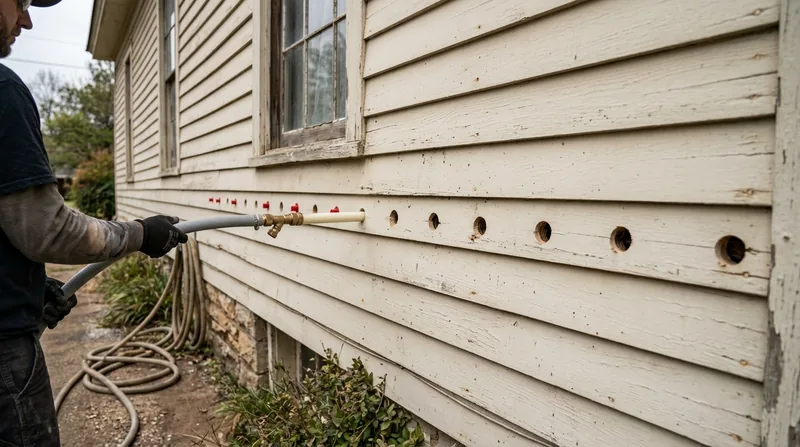




Wall & Injection Foam Insulation in Fort Smith solves a problem unique to the Arkansas River Valley: older homes built without cavity insulation now leak heat and pull in humid air through walls that were never sealed. Belle Grove historic district homes, mid-century ranches across Sebastian County, and properties in Van Buren and Alma often have empty wall cavities original to the structure. We drill small holes and inject closed-cell foam into those cavities without removing siding, restoring the thermal and moisture barrier that was never there. This retrofit works on homes from the 1920s through the 1970s, and it addresses the long cooling season and high humidity that dominate the region.
Why Wall & Injection Foam Insulation Matters in Fort Smith's Historic and Mid-Century Housing Stock
Fort Smith's building history created a widespread insulation gap. Belle Grove and downtown historic districts hold homes built before cavity insulation was standard practice. Mid-century ranches from the 1950s and 1960s across Sebastian and Crawford counties were often framed with empty wall cavities and only vented attics. Modern energy codes require insulation and air sealing, but these older homes sit uninsulated inside their walls, allowing heat to move freely through the studs and rim joists. The Arkansas River Valley's hot, humid summers mean air conditioning runs hard, and uninsulated walls let cooled air escape while outdoor humidity seeps inward. Injection foam fills those cavities without demolition, without removing siding, and without disrupting historic exteriors or HOA architectural rules.
- We drill access holes on the interior side of walls, inject closed-cell foam into each cavity bay, and patch the holes flush with the wall surface.
- The foam expands and hardens to fill the entire cavity, creating an air barrier and thermal break that stops both heat transfer and moisture infiltration.
- No siding removal means no exterior disturbance, no paint matching, and no disruption to historic or protected facades.
- The process works on single-story and multi-story walls, on homes with plaster, drywall, or paneling, and on structures from any era.
- Injection foam is closed-cell, meaning it carries an R-value of 6.5 to 7.0 per inch and resists water vapor, a critical feature in Fort Smith's humid climate.
Uninsulated walls are the silent energy leak in older Fort Smith homes, and injection foam is the only retrofit that fills them without removing the wall itself.
Local example: A 1960s ranch in Greenwood with exterior brick and empty wall cavities loses cooling all summer because the studs conduct heat directly from the outside air into the conditioned space. Injection foam fills those cavities in a single day, restores the R-value to code, and stops the moisture that would otherwise condense on the inside of the brick in humid weather.
For more information on how closed-cell foam performs in this climate, see our closed-cell spray foam insulation page.
How We Inject Foam Into Fort Smith Walls: The Process Step by Step
Injection foam work starts with a site inspection to locate studs, identify cavity depth, and check for obstructions like old wiring, plumbing, or blocking. We drill small access holes (typically 1 to 1.5 inches) on the interior side of the wall, spaced to reach every bay. The foam is injected under pressure, filling each cavity from bottom to top and expanding slightly to ensure complete contact with the studs and sheathing. Once cured, we patch the holes with foam sealant and finish them flush. The entire job is contained indoors, mechanical ventilation runs during cure, and the re-entry window is twenty-four to forty-eight hours. We provide a written estimate that specifies R-value, foam thickness per cavity, and the total board feet.
- We schedule a free on-site estimate to map the wall cavities, check for obstructions, and discuss access and patching finish.
- We drill access holes at calculated intervals and inject closed-cell foam using calibrated equipment set to the manufacturer's ratio and drum temperature.
- The foam expands and cures over twenty-four to forty-eight hours while mechanical ventilation runs continuously.
- We patch all access holes and sand or mud them smooth to match the existing wall surface.
- We provide documentation of the R-value and thickness achieved, and a one-year workmanship warranty on the installation.
The process is clean, contained, and leaves no exterior disturbance, making it ideal for Belle Grove historic homes and neighborhoods with strict architectural rules.
Fort Smith example: A 1940s brick colonial in Van Buren needed insulation in its exterior walls but could not remove the original facade. We injected foam into the cavities from inside, filled the rim joist at the foundation, and sealed the band board. The home now holds temperature in both summer and winter, and humidity stays stable because the foam blocks moisture infiltration from the exterior.
For air sealing around the foam and throughout the home, see our air sealing service page.
Injection Foam Methods and When Each Works Best
| Approach | Description | Best for |
|---|---|---|
| Closed-Cell Injection Foam | High-density foam injected into cavities, R-value 6.5 to 7.0 per inch, resists water vapor and air infiltration, cures hard in 24 to 48 hours. | Exterior walls in humid climates, rim and band joists, any wall that needs moisture control alongside thermal resistance. |
| Retrofit Injection Into Existing Cavities | Drilling access holes into walls built without insulation, injecting foam into each stud bay from the interior, no siding removal required. | Historic homes, mid-century ranches, any structure where exterior disturbance must be avoided or siding is protected. |
| Rim Joist and Band Board Injection | Injecting foam into the cavity between the rim board and rim joist, sealing the perimeter where the sill plate meets the foundation. | Homes with crawl spaces or slab foundations, any structure with exposed rim joists or band boards that pull in outside air. |
| Open Wall Cavity Fill During New Construction or Renovation | Spraying closed-cell foam directly into wall cavities when studs are exposed during framing or renovation, before drywall or sheathing is installed. | New construction, major renovations, additions, and any project where walls are open and cavities are accessible from the exterior. |
Each method delivers the same closed-cell chemistry and R-value, but the access point and timing determine which one applies to your home. Fort Smith's mix of historic preservation, mid-century stock, and new construction means injection work covers all four scenarios across Sebastian and Crawford counties.
Wall & Injection Foam Insulation Cost in Fort Smith: What to Expect
Wall and injection foam insulation in Fort Smith typically starts at $2 per square foot of wall area, with the final price dependent on cavity depth, stud spacing, access difficulty, and the total board feet required. A 1,500-square-foot home with exterior walls averaging 8 feet tall and standard 16-inch stud spacing will require roughly 1,200 to 1,500 board feet of foam, placing the job in the $2,400 to $3,000 range before any rim joist work. Homes with deeper cavities, thicker walls, or complex geometries require more material and labor. Access difficulty, such as walls blocked by interior cabinets or plumbing, can increase drilling and injection time. Getting two or three written estimates that specify R-value, thickness, and total board feet allows you to compare apples to apples. See our pricing page for a detailed breakdown of factors and typical ranges.
The cost is an investment in energy efficiency, moisture control, and comfort during Fort Smith's long cooling season. Uninsulated walls leak conditioned air and pull in humidity year-round. Injection foam stops both, often paying for itself through reduced cooling and heating bills over ten to fifteen years. We provide a free, written estimate with no obligation to book work. Call (479) 415-0861 or request an estimate online.
What to Look for When Hiring a Wall & Injection Foam Contractor Near Fort Smith
Choosing a spray foam insulation contractor in Fort Smith or nearby areas requires the same diligence you would apply to any licensed trade. Verify that the contractor is fully insured and can provide a current certificate of insurance naming your address as an additional insured. Ask for references from recent jobs in your neighborhood or similar-era homes. Request a written estimate that includes R-value, foam thickness per cavity, total board feet, and a timeline. Be wary of any estimate with no R-value or thickness specification, no mechanical ventilation plan during cure, or a promise of immediate re-entry. Confirm that the contractor understands local permitting requirements by asking which city department oversees spray foam work at your address, then verify the answer by calling the building department yourself. If your home is in an HOA or historic district, confirm that exterior drilling or patching complies with architectural review rules. A local contractor with a Fort Smith address and local plates is more reachable than a regional franchise or out-of-state rig-and-run crew if questions arise after the job. For a free estimate and to discuss your specific walls and timeline, contact us online or call (479) 415-0861.
Wall & Injection Foam Insulation in Fort Smith: Pricing Guide
| Service | Price | Details |
|---|---|---|
| Wall Injection Foam (per square foot of wall area) | Starting at $2/sq ft | Typical exterior walls, 8-foot height, standard stud spacing, includes drilling, injection, patching, and finish |
| Rim Joist and Band Board Injection | Starting at $3/sq ft | Perimeter sealing at sill plate and band board, higher access difficulty and smaller cavity volumes increase per-board-foot cost |
| Multi-story or complex wall geometry | On estimate | Homes with varied cavity depths, interior obstructions, or difficult access require on-site inspection before pricing |
| Travel and setup | Included | No separate call-out fee or mileage charge within Fort Smith, Van Buren, Alma, Greenwood, and surrounding service areas |
| Written estimate with R-value and thickness specs | Free | Response within 24 hours at (479) 415-0861, no obligation to proceed, includes site inspection and material calculation |
Indicative pricing, the exact cost depends on square footage, finish, and site access. Free personalized estimate within 24h at (479) 415-0861.


